Short answer: To start a cloud kitchen in India, you rent a small commercial kitchen space (200–400 sq ft), get an FSSAI licence (basic registration if turnover is under ₹12 lakh, State licence above that), register for GST, add a Shops & Establishments registration and a municipal trade licence, then onboard Zomato and Swiggy. A realistic single-brand setup costs ₹4–10 lakh — kitchen equipment is the biggest line, followed by deposit, software and working capital. Licences take 2–8 weeks, so file FSSAI first. From day one, build a direct channel too: a Google Business Profile, a WhatsApp ordering loop and your own menu page — because the aggregators will take 25–35% of every order once commissions, fees and GST stack up. Most cloud kitchens that die don't die from bad food. They die from paying a toll on every single sale.
That's the whole plan. Now the details — with real numbers, because "low investment, high profit" YouTube thumbnails have ruined this topic.
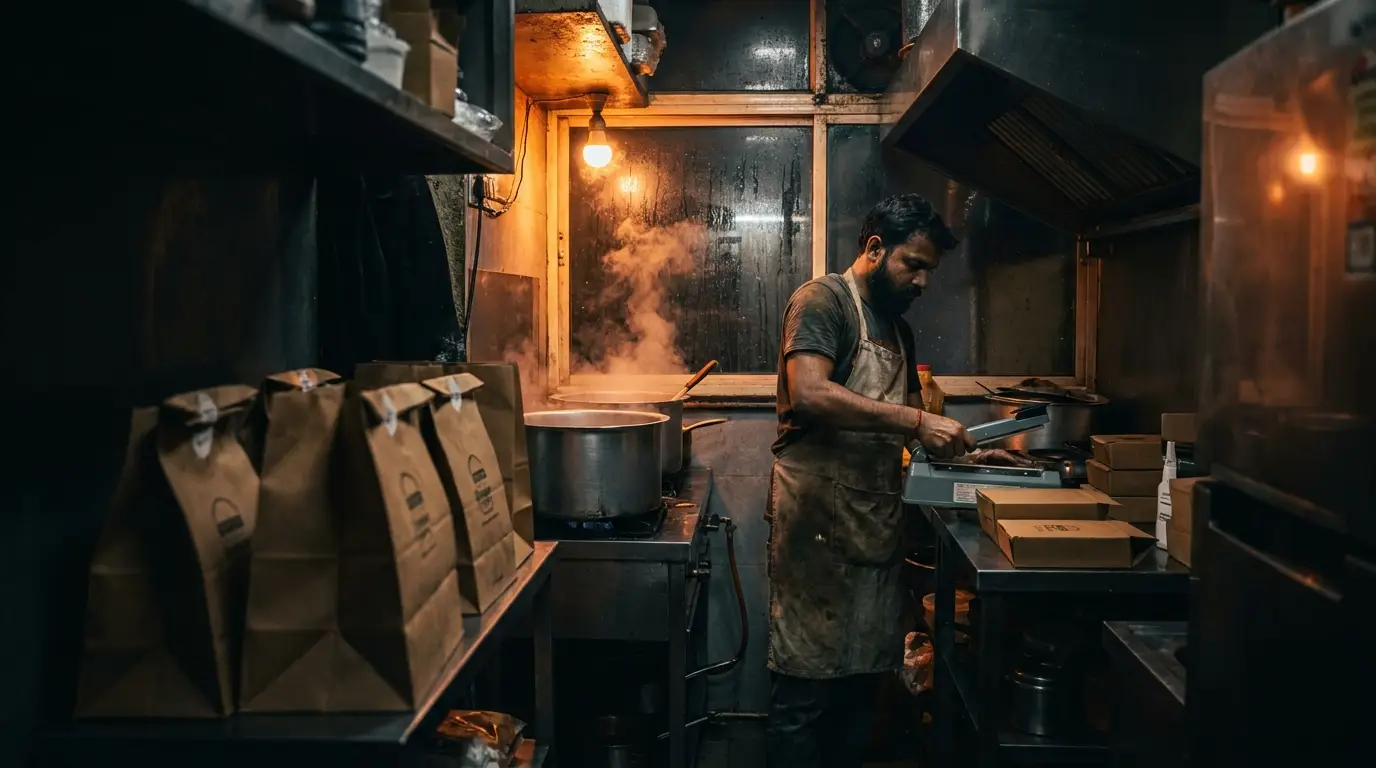
Why a cloud kitchen and not a restaurant?
A cloud kitchen is a delivery-only restaurant. No dining room, no waiters, no ₹25 lakh interior bill. You cook, the apps deliver, and your "location" is a pin on a map nobody visits.
That's the appeal: a dine-in restaurant in a metro can swallow ₹30 lakh+ before the first customer sits down. A cloud kitchen gets you selling food for a fraction of that. The catch — and it's a big one — is that you start with zero walk-in traffic and zero visibility. Every customer must find you through a screen. Which means your marketing isn't a garnish. It's the main course.
Cloud kitchen setup cost: how much does it take to start in India?
For a small single-brand kitchen in 2026, budget ₹4–10 lakh depending on city and how much equipment you buy new. Industry cost guides from Restroworks and Petpooja put a sustainable single-brand setup in the ₹3–10 lakh band, with metro setups running ₹10–15 lakh and tier-2 cities coming in around ₹5–8 lakh.
Here's the line-item view for a small kitchen:
| Line item | Realistic range (2026) |
|---|---|
| Security deposit (250–400 sq ft space) | ₹50,000 – ₹1,50,000 |
| Monthly rent (varies wildly by city) | ₹12,000 – ₹45,000 |
| Kitchen equipment (burners, fridge, prep, exhaust) | ₹1,50,000 – ₹3,50,000 |
| Licences & registrations (all-in) | ₹10,000 – ₹25,000 |
| POS + kitchen management software | ₹25,000 – ₹50,000 |
| Packaging (first stock, branded) | ₹20,000 – ₹40,000 |
| Raw materials (first 2–3 weeks) | ₹20,000 – ₹30,000 |
| Branding, menu photoshoot, launch marketing | ₹30,000 – ₹75,000 |
| Working capital buffer (do not skip this) | ₹50,000 – ₹1,00,000 |
Two ways to cut this down. Used equipment — restaurant churn in India is brutal, and someone's failed dream is your discounted deep fryer. Shared/co-working kitchens — you rent a ready commercial kitchen by the shift, ducking the deposit and equipment lines entirely while you validate the menu.
Two places never to cut: the exhaust system (your landlord and your neighbours will end you) and the working capital buffer (month two always costs more than the spreadsheet said).
City changes the setup cost more than any other variable — rent and deposits do the damage:
| Where you set up | Realistic total setup cost |
|---|---|
| Metro (Bengaluru, Mumbai, Delhi NCR) | ₹8 – 15 lakh |
| Tier-2 city (Jaipur, Kochi, Indore) | ₹5 – 8 lakh |
| Tier-3 city / outskirts | ₹4 – 6 lakh |
| Shared / co-working kitchen (any city) | ₹1 – 3 lakh to start |
| Home kitchen (validation stage) | ₹50,000 – 1.5 lakh |
Can you start a cloud kitchen from home in India?
Legally, yes — and for a first-timer it's often the right move. A home kitchen with turnover under ₹12 lakh/year can operate on a basic FSSAI registration, and Zomato and Swiggy do list home-based sellers. Your setup cost collapses to roughly ₹50,000–1.5 lakh: packaging, a licence, decent photos, maybe a second burner and a bigger fridge.
The honest caveats, before your society WhatsApp group discovers them for you:
- The apps still want paperwork. GST registration and professional food photos are effectively mandatory to get listed and get orders.
- Residential societies can object to commercial cooking — smells, gas cylinders and delivery riders in the lobby age badly with neighbours.
- You can't scale from a home stove. Past 20–30 orders a day, prep times slip, ratings fall, and the algorithm buries you.
Treat home as a ₹50,000 validation lab: prove the menu sells, learn your food costs, build your first hundred regulars. When orders are consistent, graduate to a small commercial space — the FSSAI licence scales up cleanly, and your direct-channel work (Google Business Profile, WhatsApp ordering) moves with you at zero cost.
What licences does a cloud kitchen need in India?
Delivery-only does not mean regulation-free. A cloud kitchen is a food business under the FSS Act like any restaurant, and the apps will ask for your paperwork before they list you.
| Licence / registration | Who needs it | Notes |
|---|---|---|
| FSSAI Basic Registration | Turnover under ₹12 lakh/year | Apply on FoSCoS, the official FSSAI portal |
| FSSAI State Licence | Turnover ₹12 lakh – ₹20 crore | Most serious cloud kitchens land here; may involve an inspection |
| FSSAI Central Licence | Turnover above ₹20 crore or multi-state ops | Not a day-one problem — a good problem to have |
| GST registration | Effectively everyone | Zomato and Swiggy require a GSTIN to onboard you |
| Shops & Establishments registration | All commercial premises | State-specific; usually quick and cheap |
| Trade licence | From your municipal corporation | Confirms the premises can legally run a food business |
| Fire NOC | Larger kitchens / per local rules | Commercial gas setups often trigger this — check your city's norms |
The turnover slabs are the ones that trip people up, so to be precise: basic registration covers turnover up to ₹12 lakh, the State licence covers ₹12 lakh to ₹20 crore, and the Central licence kicks in above that or when you operate across states — confirmed across IndiaFilings and Vakilsearch. If you expect real volume, apply for the State licence directly and skip the upgrade paperwork later.
File FSSAI first — it's the slowest, and your 14-digit licence number has to appear on packaging and app listings. Budget 2–8 weeks for the full licence stack.
The step-by-step launch sequence
- Pick one cuisine and a tight menu. 8–12 items that travel well in a box. Biryani survives a 25-minute ride; a soufflé does not.
- Choose the location for delivery radius, not footfall. You want a cheap space inside a 5–7 km ring of hungry, order-happy neighbourhoods. Back lanes are fine. Back lanes are ideal.
- File the licences (table above), starting with FSSAI on FoSCoS.
- Fit out the kitchen — equipment, exhaust, storage, and a POS that pipes Zomato, Swiggy and direct orders into one screen.
- Onboard the aggregators. Professional food photography here is not vanity; it's your entire storefront.
- Set up your direct channel on day one — Google Business Profile, WhatsApp ordering, your own simple menu page. Read the next section for why this isn't optional.
- Soft launch, fix, then push. Two quiet weeks to stabilise prep times and packaging before you spend a rupee on promotion.
The growth math: why the apps decide whether you survive
Here's the part the "start a cloud kitchen with ₹2 lakh!" videos skip.
A dine-in restaurant has walk-ins, regulars, a signboard. A cloud kitchen has one artery: the apps. And the apps charge for the privilege. Zomato's base commission runs 18–28% and Swiggy's 17–25% — and once you add payment collection fees, platform fees and GST, the effective deduction lands at 25–35% of every order, per detailed 2026 fee breakdowns from Menuviel and MenuManager.
Run the math on a ₹400 order at a 30% effective cut: ₹120 gone before ingredients, packaging, rent or gas. Food costs eat another 30–35%. What's left has to cover everything else — including the ads you'll run inside the apps to stay visible. This is the sin tax of the cloud kitchen model: the same platforms that give you customers quietly cap how profitable each customer can ever be.
The fix is not to rage-quit the apps. They're discovery — genuinely good at putting your brand in front of strangers. The fix is the funnel we've written about before: apps for the first order, direct for every order after. That means:
- A Google Business Profile that ranks in the map pack when someone searches "biryani delivery near me" — yes, cloud kitchens can and should have one
- A WhatsApp ordering loop with a QR insert in every delivery box: "Order direct next time — same price, faster, and you help us skip the 30% fee"
- A fast mobile menu page so "direct" doesn't mean "phone call and a prayer"
Every regular you move to direct is a customer whose margin roughly doubles. We've broken down the full playbook in how restaurants escape Zomato and Swiggy commissions, and if you want to see what we actually build for food businesses, that lives on our cafés & restaurants page.
A cloud kitchen that treats the aggregators as its only channel is a tenant forever. One that builds direct orders from day one is buying its freedom on an EMI.
FAQ
Can I run a cloud kitchen from home in India?
Yes — turnover under ₹12 lakh/year needs only a basic FSSAI registration, and the apps list home sellers. Budget ₹50,000–1.5 lakh and treat it as a validation lab; the full trade-offs are covered in the from-home section above.
How much commission do Zomato and Swiggy charge cloud kitchens?
Base commissions run roughly 18–28% on Zomato and 17–25% on Swiggy, but the number that matters is the effective deduction: after payment collection fees, platform fees and GST on all of it, most kitchens surrender 25–35% of order value. Cloud kitchens often sit at the higher end because, with no dine-in brand pulling customers, they have weak negotiating leverage. High-volume outlets can haggle a few points off. The cheaper structural fix is moving repeat customers to a direct channel that charges 0%.
How long until a cloud kitchen breaks even?
For a well-run single-brand kitchen, 6–18 months is the honest range. The maths is simple even if the grind isn't: if you clear ₹80–100 net per order after food cost, commissions and packaging, and your fixed costs are ₹80,000–₹1.2 lakh a month, you need roughly 30–45 orders a day to stop bleeding. Kitchens that build direct orders early hit break-even faster, because every direct order carries 25–35% more margin than the same order through an app. Kitchens that rely purely on in-app ads tend to break even never.
Starting the kitchen is the easy half. Getting found — on Google, on Maps, and off the aggregator toll road — is where most cloud kitchens quietly starve. If you'd rather we build that visibility engine while you handle the food, book a call. It's free, it's honest, and there's no lock-in — we're sinners, not captors.